
The La Crosse Public Library occupies the ancestral lands of the Hoocąk (Ho-Chunk) and Dakhóta (Dakota), who have stewarded this land since time immemorial.
What we now call the city of La Crosse occupies land that was once a prairie that was home to a band of Hoocąk. In 1830, President Andrew Jackson signed the Indian Removal Act in an attempt to violently remove Indigenous peoples from their ancestral lands located east of the Mississippi River to occupied territory west of the river. Beginning in the 1830s through the 1870s, the Federal Government conducted a series of eleven attempts to forcibly remove local Hoocąk to reservations in Iowa, Minnesota, South Dakota, and finally to Nebraska. During the 1848 removal, the U.S. Army appointed La Crosse as a rendezvous location to force Hoocąk families onto steamboats to remove upriver. This happened at the historic steamboat landing that is now the entrance into Riverside Park in downtown.
However, many Hoocąk found their way back to their homeland here in La Crosse and eventually the federal and local governments moved on to new strategies to eradicate Indigenous folks and culture from the newly established United States of America.
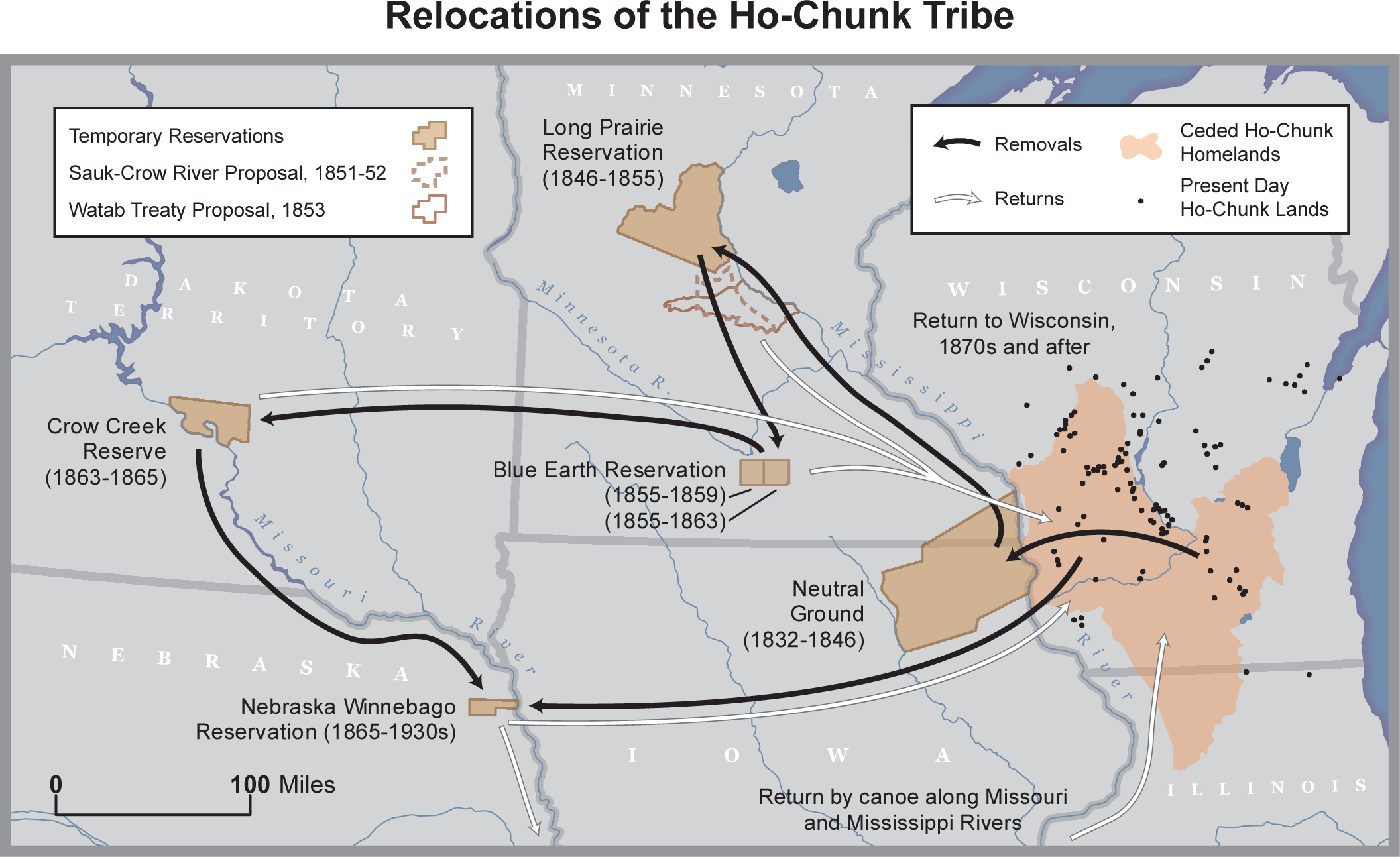
This map shows the forced removals (black arrows) and the returns that the non-treaty-abiding Hoocąk made back to their homelands (white arrows) after each removal. Map made by Cole Sutton.
As of 2020, Wisconsin was home to 5,505 members of the Ho-Chunk Nation, about 290 of whom live in La Crosse County.
To learn more about this history, go to Hinųkwas: A Reexamination of Our History, an online exhibit with resources created in partnership with the Ho-Chunk Nation La Crosse Youth & Learning Center. You might also check out the Library's Indigenous Peoples Spotlight Collection of Turtle Island, which features books for all ages written by Indigenous authors.